
You might think curating a gift selection is easy: browse the trends, pull popular products, sort them. But at Ohmywishes, we have an entire editorial team dedicated to this work — because algorithms rarely know how to pick a genuinely great gift.
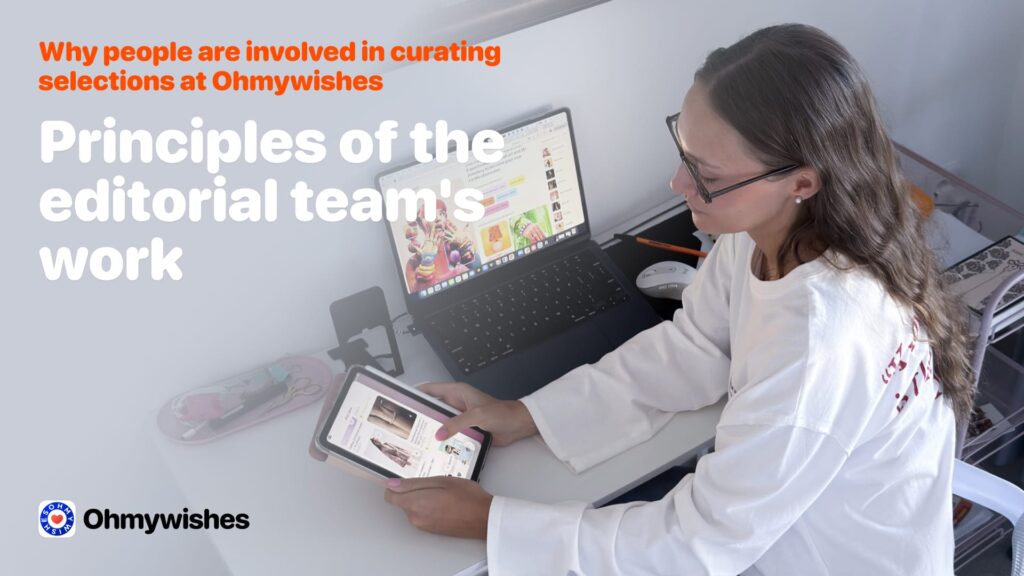
My name is Kseniia, and I’m the Editor-in-Chief of Curated Selections at Ohmywishes. Together with my team, we maintain the quality of our gift guides, develop new categories, and tackle the same challenge every single day: how do you help someone find a gift that will actually make another person happy?
Not Just a Gift Catalog
Selections or gift idea lists have existed almost since the very beginning of Ohmywishes. In the early days, they were put together by Azamat — the founder of the service. Over time, we saw how people responded to them, and it became clear that the selections needed to grow: to become more lively, more varied, and more useful to our users. That’s how the editorial team came to be.
We now have 15 editors, each responsible for a specific topic: beauty, fashion, electronics, jewelry, home goods, and more. But why go to all this trouble?
The answer is simple: people often have no idea what to give someone. And sometimes, they don’t even know what they want for themselves. That’s exactly where our work begins. We try to build those gift idea lists not to fill space, but so that someone can open one and think: “Oh, that would be perfect for my friend” or “That’s exactly what I’ve been wanting.”
A Great Selection Is a Balancing Act
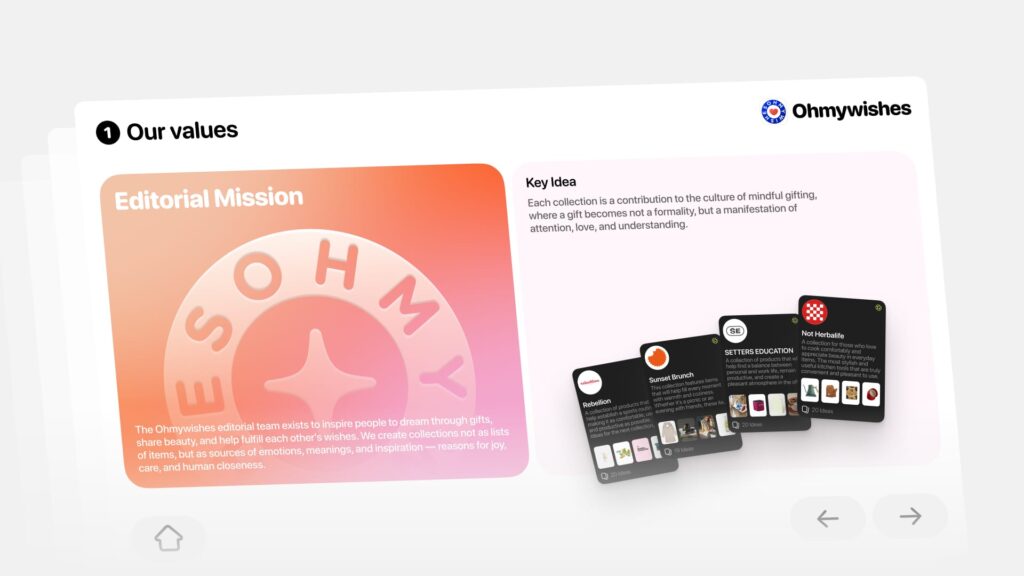
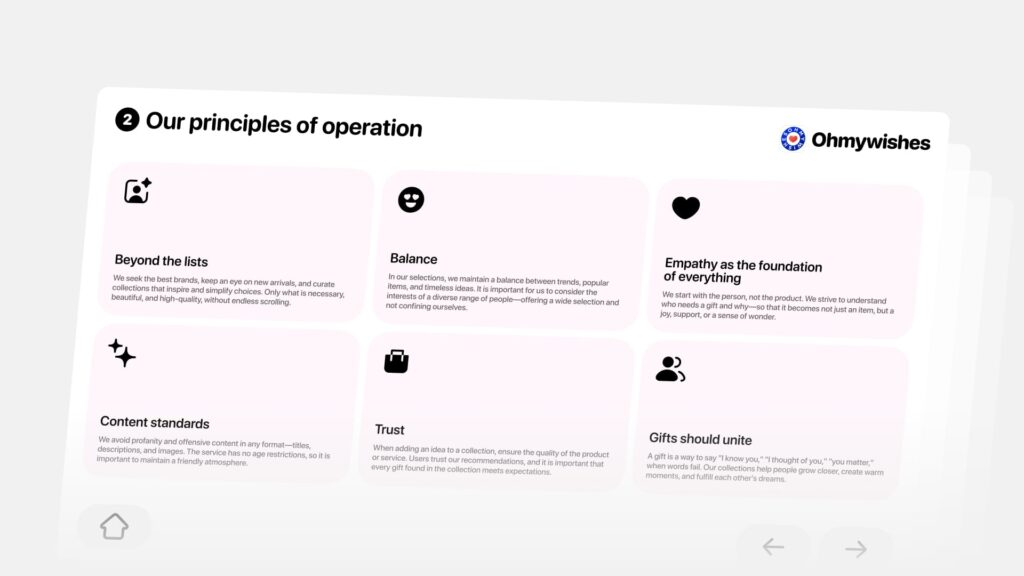
Our main editorial principle is probably this: don’t let selections turn into an automatically updated catalog. Of course, we track trends, new arrivals, brands, and social media. But just because something is popular doesn’t mean it belongs into a selection. In our children’s categories, for instance, we try not to flood the selection with basics that parents would find on any marketplace anyway.
We’re more interested in offering something new — something the user might not have thought of themselves. At the same time, it’s important not to go too far in the other direction, into niche or overly unusual ideas.
For us, a good selection is always a balance. On one side — trendy, in-demand items that a lot of people want. On the other — timeless ideas that make for a good gift regardless of the season or what’s fashionable right now.
Why We Don’t Add Everything
When someone opens a selection, they should feel confident that every item was chosen deliberately. So we look beyond product quality — we also consider the brand’s ethos, how the item is presented, and the overall impression it leaves.
The second thing we think about is context. Our homepage might feature anything at once: home décor, fitness gear, gifts for kids, for men, for women, electronics, skincare. But within a themed selection, everything should feel coherent and easy to navigate.
Some items genuinely sit on the border between categories, and part of an editor’s job is figuring out how to fit them into the larger structure in a way that makes sense. Because a good selection isn’t just a set of ideas — it’s a smooth, intuitive journey for the user.
The Work Is Really About Understanding Other People
Most of what we do is observation. We track trends, monitor social media, follow brands and local makers, look at what users are saving, and talk through ideas as a team. But the hardest part is stepping outside your own bubble. You have to keep thinking about people with completely different backgrounds, ages, interests, and lifestyles — and their tastes are endlessly surprising.
Once, I added a digital piano from a small local independent brand to our homepage. Honestly, I wasn’t expecting much from it. Musical instruments felt like a niche category compared to, say, sneakers or skincare.
But that piano became one of the most-saved items on the entire homepage. I think it worked because it didn’t look like a musical instrument in the conventional sense — minimalist design, compact size, the ability to fold it nearly flat against a desk. It felt more like a beautiful piece of furniture than a piece of technology.
People probably looked at it and thought: “I didn’t know something like this existed.”
This is exactly why we pay so much attention to local and independent brands. They often make the most original, alive, and authentic things — you can feel a specific person and their vision behind them. And it’s those kinds of discoveries that make our selections feel human.
AI Can’t Make Good Gift Ideas Lists
Yes, an automated system can analyze statistics, page views, trends, and user behavior. It can quickly aggregate popular products and predict what someone is most likely to click on.
But the problem is that algorithms simply show you what you’ve already seen. Editors work differently: they filter ideas through the prism of their own taste, their own experience, and a genuine desire to understand other people.
I like the idea that taste isn’t just the ability to choose something beautiful. It’s a social skill — the ability to connect an object with a specific person, their life, their habits, their desires. That’s why editorial work is fundamentally built on empathy.
The Hardest Part of Our Work Is Being an Editor All the Time
I think any gift editor eventually starts seeing the world a little differently. You’re walking through a store, scrolling through your feed, noticing something at a friend’s place or catching a glimpse of something on the street — and you automatically find yourself thinking: “Could that be a great gift?”
On one hand, it’s genuinely interesting. On the other, it’s pretty exhausting, because you’re constantly inside an enormous stream of information.
But maybe that’s exactly what keeps our selections alive — and keeps Ohmywishes one of the leaders in the market.
